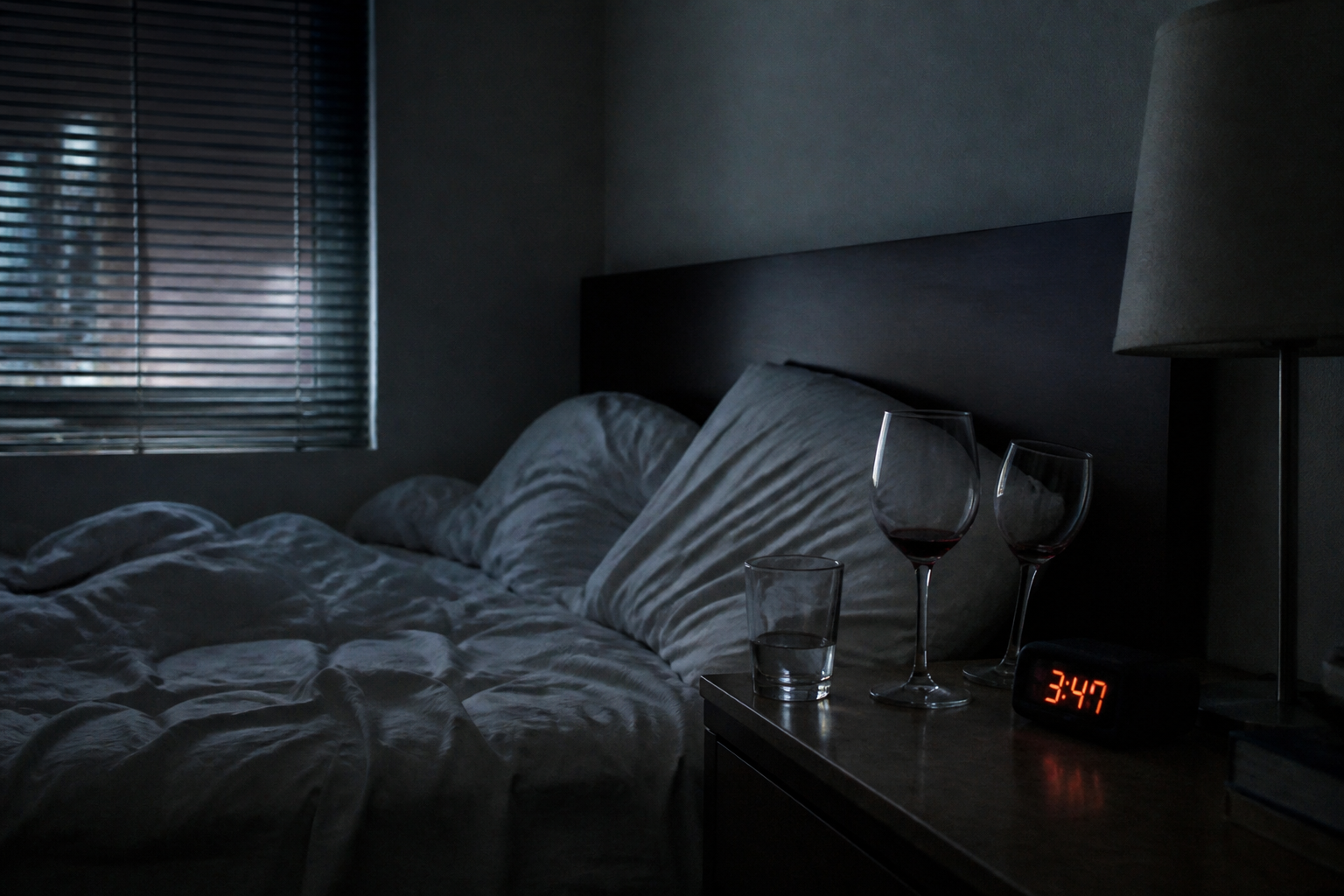
I used to treat a couple of beers as sleep hygiene. Tired from work, a little warm, lights down, out in twelve minutes. The watch told a different story in the morning, and I spent a year arguing with the watch.
Alcohol is a sedative. Sedation is not sleep. You lose consciousness on purpose. The architecture underneath that still has a job to do, and ethanol is messy about the job. If you came here for a TED-talk about “mindful drinking,” this is the wrong page. If you want to know why you feel like you got hit by a bus after “only two,” keep reading.
What actually breaks
The first half of the night often looks fine. You drop off faster. Some wearables even give you a cute score because time-in-bed went up.
Then 2 or 3am arrives. Heart rate is higher than it should be. You wake to pee. You do not go back down the same way. REM gets pushed later and chopped up. Slow-wave sleep in the second half is thinner. You remember this as “I slept, I just feel hungover for no reason.”
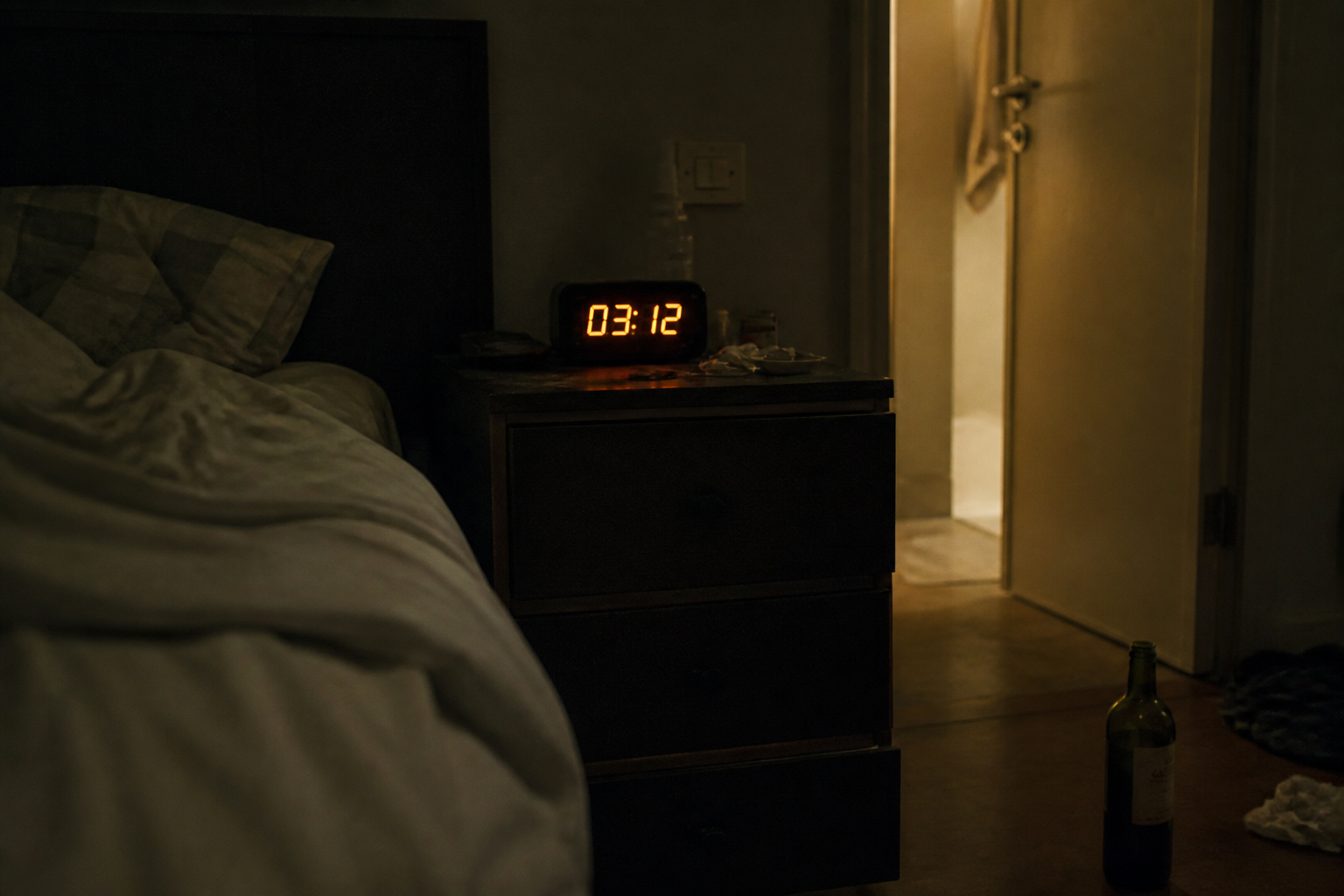
That pattern is not a personality. It is pharmacology. Ethanol is metabolized at a fairly stupid, linear-ish rate. While it is still in you, it sedates. As the level falls, you get a rebound: more awakenings, more sympathetic noise, less of the sleep stages that make the next day usable. Roehrs and Roth have been writing this up for years in the sleep literature. Ebrahim and colleagues mapped how even “moderate” evening doses shuffle REM. You do not need a PhD to notice it if you have a watch and a honest Tuesday.
There is a dose that is honest. One drink with dinner, finished three hours before bed, is a different animal than two neat ones at 10:30 while you “wind down” on the couch. The second version is the one I see in men who swear they have a sleep problem and also have a wine problem they have not named.
A week I actually logged
I am not a sleep lab. I am a person with an old Polar-style habit of writing numbers down. For seven nights I kept bedtime inside a 30-minute window, caffeine cutoff at 2pm, and no other heroic changes. Nights 1-3: two drinks finishing around 9:30. Nights 4-7: zero.
Waking heart rate sat about 8 to 11 beats higher after the drinking nights. I woke after 2am on two of the three drinking nights and none of the dry ones. The wearable “sleep score” barely moved, which is why I do not worship the score. The morning did.
That is an n=1 with a notebook. It will not get into The Lancet. It is also why I stopped using beer as a sleep aid. Your week might look different. Run it anyway. A slogan is not a test.
Testosterone and the boring morning
A heavy night does not castrate you. It does knock luteinizing hormone around for a stretch, and it raises next-day cortisol in a lot of people. Combined with short REM, the morning often feels flat in a very specific way: coffee works worse, the gym feels heavier, you are impatient with emails that would have been nothing on Wednesday.
If you already sit in the gray zone on total T, this is not the lever I would ignore while ordering ashwagandha. The ashwagandha industry is not going to tell you to skip the second pint. I will.
Apnea makes all of this worse. Alcohol relaxes the airway. If you snore like a tractor after two glasses, the “sleep problem” is not mysterious. Get a partner, a recorder, or a proper study. Do not buy a mouth-tape kit and call it a protocol.
Who this is not for
If you have alcohol use disorder, a “two-week test” is not treatment. Talk to a clinician. If you are on sedatives, mixing ethanol is a different kind of stupid than a sleep-score argument. If you have liver disease, this article is not your permission slip to “moderate.”
A week that is actually a test
Do not “cut back.” That is a slogan. Run a week with a rule you can check.
- No alcohol after 7pm.
- Two nights with zero, not “just a sip.”
- Same bedtime, same room, same wearable if you have one.
Look at resting heart rate on waking, and how many times you remember being awake after 2am. If both look quieter, you have your answer. If nothing changes, your problem is probably light, apnea, or the 11pm emails, and you can stop blaming the pint.
Keep the notes somewhere you will actually look at on Sunday. A screenshot folder named “sleep” is enough.
Common questions
Is red wine different because of resveratrol? Not at the volume that gets you to sleep. The polyphenol story does not rescue the second half of the night.
What about a “nightcap” tradition? Traditions can be wrong. This one is wrong for sleep architecture even when it feels kind.
Can I drink at lunch and be fine at 11pm? Often closer to fine than a 10pm pour, because more of the dose is gone. Not a license to stack four pints at noon and expect a perfect night. Food, body weight, and how fast you drink still matter.
Do sleep pills cancel this? They can knock you out. They do not rebuild the night alcohol just took apart. Stacking sedatives is a conversation with a doctor, not with a blog.
I still drink. I do not drink as a sleep aid. Those are different hobbies, and mixing them made me worse at both.
Sources
- Roehrs T, Roth T. Sleep, sleepiness, and alcohol use. Alcohol Res Health. (review of ethanol vs sleep stages and next-day function)
- Ebrahim IO, et al. Alcohol and sleep I: effects on normal sleep. Alcohol Clin Exp Res. 2013.
- Colrain IM, Nicholas CL, Baker FC. Alcohol and the sleeping brain. Handb Clin Neurol. 2014.
- NIH / NIAAA. Sleep and alcohol fact pages (public summaries of the same architecture story)
Science edit: Lena Park. If a citation is misquoted, email the desk.