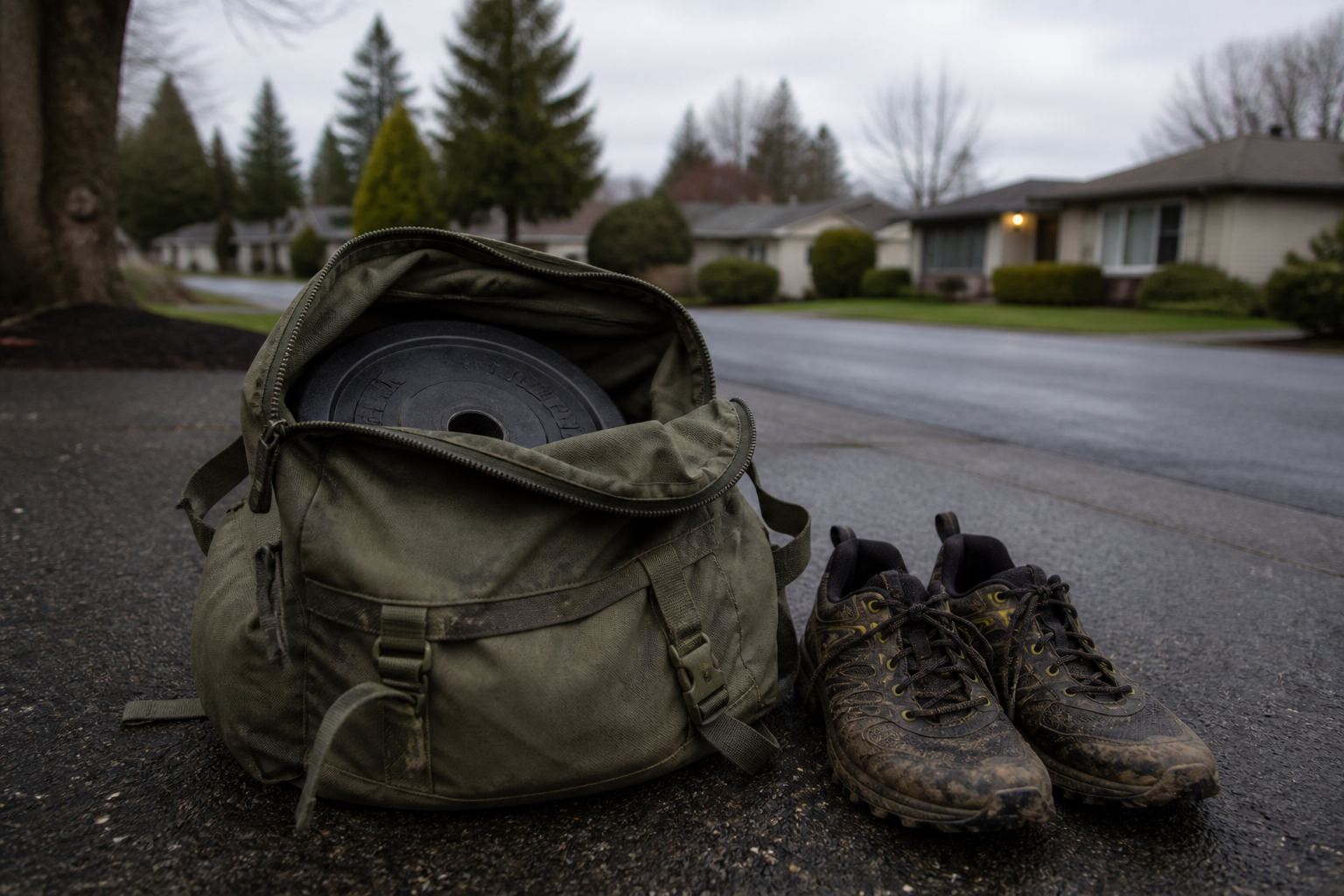
I like the gym. I also skip the gym. A pack with a plate in it has survived more of my bad weeks than any program I downloaded.
Rucking is walking with a load. Soldiers did it because they had to move gear. The rest of us do it because Zone 2 on a treadmill is a special kind of boredom, and because bone and tendons need some compression that a 5k jog does not always give you after 40.
Load carriage has a research trail that is not a TikTok. Military and occupational papers have tracked energy cost, foot injuries, and how mass on the trunk changes gait. You do not need to join an army to steal the useful bit: walk, add weight slowly, keep the pack high and close, stop when your shoulders live by your ears.
How heavy
Start with 10% of bodyweight. If you weigh 90kg, that is 9kg, not 25 because a podcast guy looks like a door. Add a few kilos when the walk feels like a walk, not a hike you have to recover from.
I use a stiff backpack and a single plate so the weight sits high and close. A floppy daypack full of books swings and wrecks your lower back. Shoes you already walk in are fine. Fancy “ruck clubs” are optional.
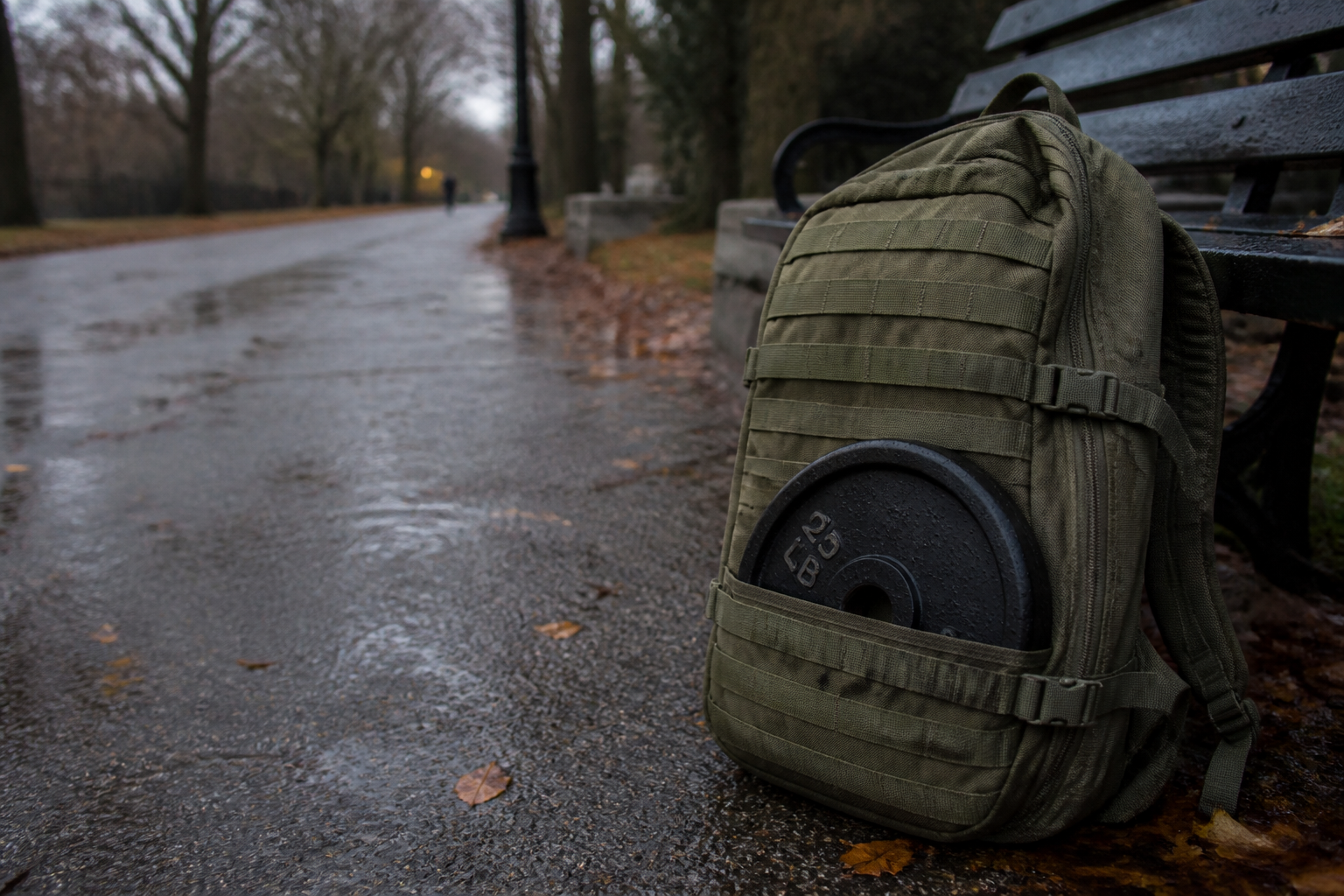
If you have a disk history, you do not start at 20kg to prove a point. You start empty, then a water bottle, then a plate. Pain that shoots down a leg is not “hormesis.” It is a stop.
How far
Forty minutes, most days I can. Hills count extra. If your heart rate sits in an easy conversational zone, you are in the right neighborhood. If you are gasping, the pack is too heavy or your upper back is not ready.
Twice a week I will go longer, 75 to 90 minutes. That is the session that actually moves the endurance needle. The short ones keep the habit from dying.
I log these the same way I log lifts: date, minutes, pack weight, whether I could talk. If I cannot talk, it was not the easy aerobic work I thought I was doing. It was a poorly designed interval.
What I actually ran for eight weeks
Weeks 1-2: 8kg, 35 to 40 minutes, flat neighborhood. Weeks 3-5: 12kg, same time, one hill loop. Weeks 6-8: 12kg, one 80-minute weekend walk.
Resting heart rate on waking drifted down about 4 beats by week 8. Body weight did not move much. The thing that moved was “I will still train on the weeks I hate the gym.” That is the longevity play most programs miss. The best protocol is the one that is still there in November.
Bone is slower. You do not DEXA after eight weeks and throw a party. Load-bearing walking is still one of the saner osteogenic habits we have that does not require a bumper plate and a coach. If your last DEXA was a mess, this is complementary to lifting, not a replacement.
What it is not
It is not a squat replacement. It will not give you a deadlift. If you only ruck and never lift, you will have decent legs and a back that still cannot pick a suitcase up without thinking about it.
It is also not “cardio you can do in dress shoes.” I tried that. Ankles complained. Blisters are the amateur tax. Sock choice is more important than the brand of pack.
People with uncontrolled hypertension, recent stress fractures, or a surgeon who said “no load on that joint” do not get a blog override. Sit this out or get a clearance that is actually a clearance.
Common questions
Plate or sandbag? Plate in a stiff pack sits better for me. Sand shifts. If all you have is a bag of rice, start there and buy a plate later.
Can I run with the pack? You can. Most people should not, at first. Walking is the point. Running with load is a different injury catalog.
Heart-rate zone? Easy conversation. If you need numbers, think roughly 60 to 70% of max for a lot of people, but max estimates are sloppy. Talk test first.
Is rucking “Zone 2”? It can be. It can also be Zone 3 in disguise if the pack is heavy and you are proud. Swallow the pride.
The honest pitch: you get a walk, some extra bone loading, and a reason to leave the house when the barbell feels like a project. That is enough for a lot of weeks.
Sources
- Knapik JJ, Reynolds KL, Harman E. Soldier load carriage: historical, physiological, biomechanical, and medical aspects. Mil Med. 2004.
- Paluch AE, et al. Steps per day and all-cause mortality in middle-aged adults. JAMA Netw Open. 2021 / related step-count mortality work.
- Kohrt WM, et al. Physical activity and bone health (ACSM position / related reviews on load and bone).
- American College of Sports Medicine. Walking and load as part of aerobic activity guidance (public position materials).
Science edit: Lena Park.