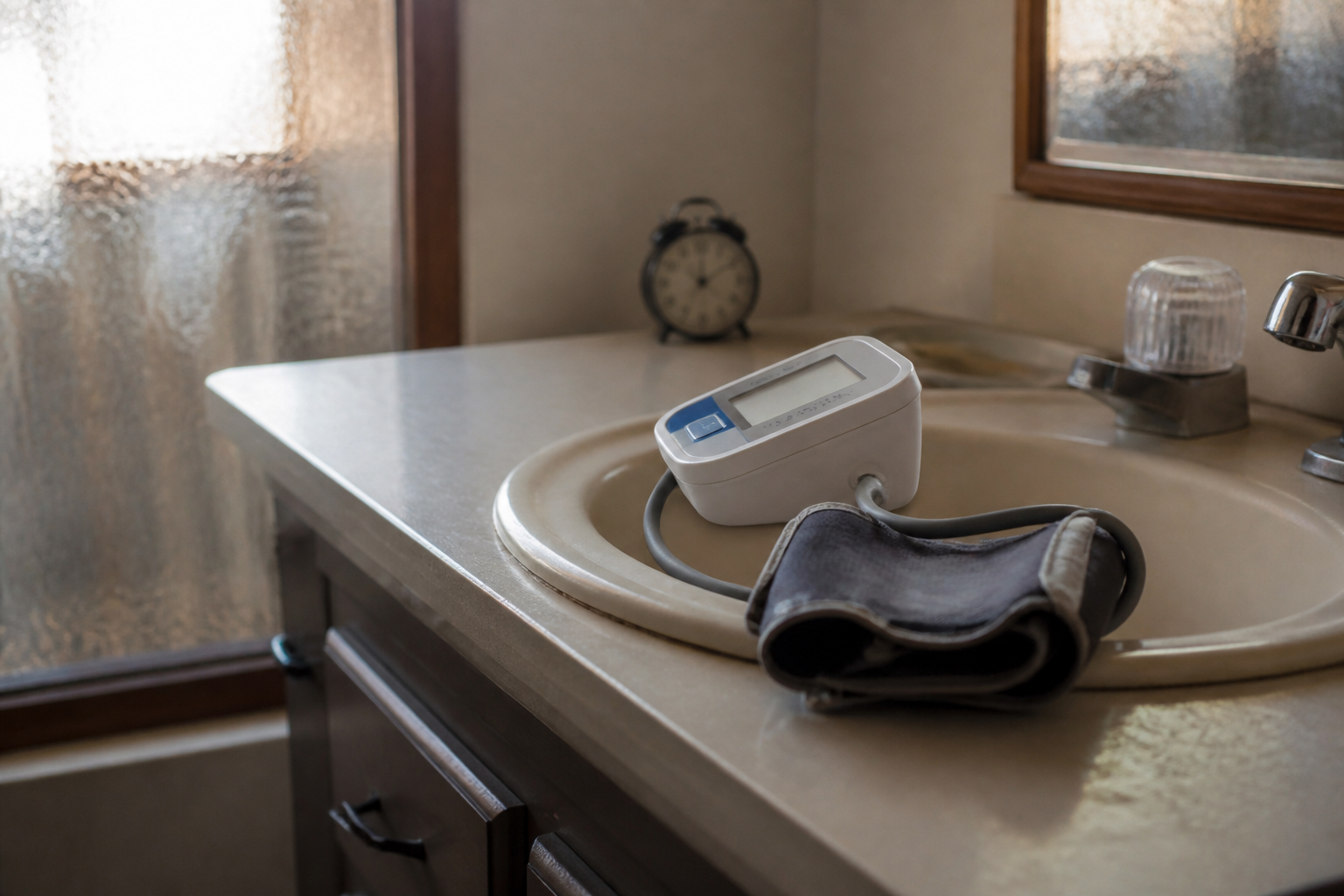

I used to treat blood pressure like weather. One ugly reading at a desk after a sprint from the car, then I decided I was “a bit high when stressed.” The nurse had talked through the whole measurement. My legs were crossed. I had coffee on the drive. That number was a personality test, not a vascular one.
Home blood pressure, done like a dull ritual, is one of the few bits of men’s health kit that is cheap, repeatable, and actually in the guidelines. It is also easy to fake without meaning to. This piece is about not faking it.
I am not diagnosing hypertension. I am telling you how to collect a week of numbers a clinician can use, and how I finally stopped arguing with a single spike.
Why the kiosk lies in both directions
Pharmacy machines are often on a stool in a fluorescent aisle. People lean forward. The cuff is the wrong size. Someone is waiting. You just walked the store. White-coat effect in clinic is real: some men run high only in a medical room. Masked hypertension is the opposite: normal in clinic, high at 6am in your own kitchen. A one-off anywhere is a coin flip.
Guidelines from the American Heart Association and European societies keep repeating the same boring setup because the boring setup is the intervention. Unattended office readings, home averages, ambulatory 24-hour monitors: all of them beat “I felt fine at the dentist.”
If your doctor already put you on a drug, this article does not get a vote. You measure how they told you to measure, and you do not skip pills because a blog described a sit.
The sit
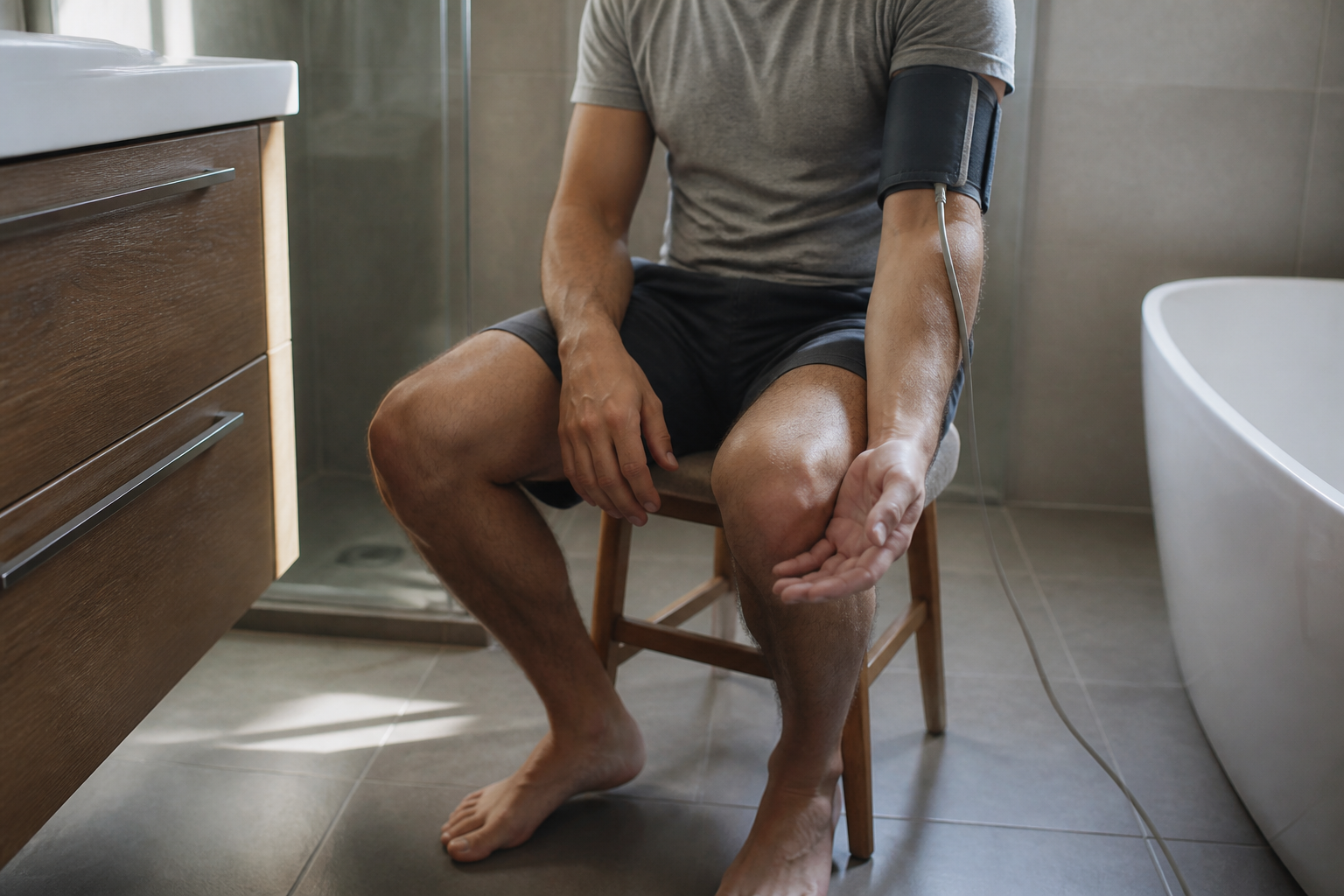
Upper-arm cuff. Validated device if you can (lists exist; I am not going to pretend a random Amazon special is automatically trash, but wrist toys are how you collect fiction). Cuff bladder on bare skin, not over a hoodie. The artery marker, if there is one, roughly over the inner arm.
Sit. Back supported. Feet flat. Arm supported at heart level, not hanging, not shrugging. You do not talk. You do not scroll. Five minutes is the number people skip because five minutes feels like a waste. It is the whole method.
Then two readings, a minute apart. I log both. Some protocols average them. I care more that they exist than that I invented a third statistic.
Morning, before coffee, after the bathroom, is a useful default. Evening is a second series if you are doing this properly for a week. Do not measure only after an argument. Do not measure only when you “feel high.” That is how you confirm a mood.
Cuff size is not a vibe. A cuff that is too small reads high. Too large reads low. Measure the mid-upper-arm circumference once like an adult buying a shirt.
What the numbers even are
Systolic is the top. Diastolic is the bottom. Units are millimetres of mercury because medicine is old. Clinic thresholds and home thresholds are not always identical. Home averages used in hypertension workups are often a bit lower than office cutoffs, which is another reason a kiosk panic is not a care plan.
I will not paste a full treatment table. Cutoffs move, your risk stack (diabetes, kidneys, prior stroke) changes the conversation, and a writer without your chart should not play internist. What I will say: repeated home averages that sit in the range your clinician called “too high” are a reason to use the phone, not a reason to buy a supplement with a beetroot drawing.
People love pulse pressure (the gap between top and bottom) as a cocktail fact. Fine. Do not build a religion on one gap from one evening.
A week I actually logged
I bought a basic upper-arm unit after a clinic reading of 148/92 with me chatting about traffic. At home, five-minute sits, no talking, six mornings: mostly 128 to 136 systolic, diastolic in the low 80s. One morning 142 after I cheated and measured standing in the kitchen with the radio on. I threw that one out of the average because it was a different experiment.
The useful output was not “I reversed aging.” It was a sheet I could hand over. The clinician cared about the average and the method. They did not care about my theory of the kiosk.
When I travel, I get sloppy. Hotel desks, wrong chair, espresso first. Those weeks look noisier. That is information about my habits, not a new disease.
If a home series is suddenly 180s, or you have chest pain, breathlessness, a neurological change, vision loss, you stop reading blogs. That is urgent care. A “protocol” is not a 999/112/911 substitute.
How I write it down so it is not theater
I use a paper grid: date, time, arm, reading 1, reading 2, notes (coffee already, bad sleep, skipped sit). The notes column is where the lies would go if I did not write them. “Talked to my son through the cuff” is a ruined row. I keep seven morning pairs before I bother a clinician with a photo of a single 142.
Some apps average for you. Fine. I still want to see the raw pair. A device that only shows a “wellness score” is a toy. I want millimetres of mercury.
Night-shift people cannot worship 6:40am. Measure after the longest sleep you actually get, before the stimulant, same ritual. Consistency beats cosmology.
If you already take a pressure drug, ask the prescriber when to measure relative to the pill. I will not invent that timing for you. Skipping a dose to “see the real number” is a different experiment and usually a bad one.
Sharing a cuff with a partner is fine if the cuff still fits both arms. It often does not. Measure the arm, not the marriage.
Failure modes I keep seeing
Wrist cuffs at the wrong height. Talking. Caffeine. A full bladder. Legs crossed like a talk-show guest. Measuring over clothing. One reading, then a story. Sharing the device with a partner without checking the cuff fit. Competing with your own previous number in real time, which raises the next one. I have done most of these.
Arrhythmia flags on some machines. If the device keeps complaining, that is a clinician question, not a battery question.
People with known aortic disease, certain arm issues, fistulas, lymph node dissections: you get a specific method from the person who operates on you. Do not crowd-source which arm.
Common questions
Which arm? Use the arm your clinician prefers. If you are screening, try both once. Big, consistent differences belong in a note to a doctor, not in a forum.
How many days? A week of morning and evening pairs is a classic home series. Two heroic measurements are not.
Can I use a wearable BP? Some cuffs now pair with phones. The sit still matters. A pretty app does not replace arm position.
What about breathwork to “lower it for the reading”? Then you measured breathwork. If you want the number your vessels actually live with, sit quietly without performing.
Salt? Sodium can move BP in salt-sensitive people. That is dietetics and cardiology, not a weekend challenge I will prescribe from here.
Exercise right before? Wait. Training raises pressure. Measure on a rest morning if you are trying to see the baseline.
What this is not
It is not a methylation test. It is not “vascular age.” It is a pressure in a tube, averaged, with a method. The lifestyle score on this site is a quiz. This is a cuff. Do not mix them.
If you want the adjacent files: morning resting heart rate, ApoB and the rest of the panel, erections as a vascular clue. None of those replace a week of sits.
Sources
- Muntner P, et al. Measurement of blood pressure in humans: AHA scientific statement. Hypertension.
- Williams B, et al. ESC/ESH guidelines for the management of arterial hypertension (use the current revision your clinician uses).
- NICE NG136 (UK): hypertension in adults, including home and ambulatory monitoring context.
- STRIDE BP / independently validated device lists (search the current list; models change).
- Pickering TG, et al. Recommendations for blood pressure measurement in humans and experimental animals (methods papers still cited for the sit).
Science edit: Lena Park. Not a diagnosis. Not a drug decision.