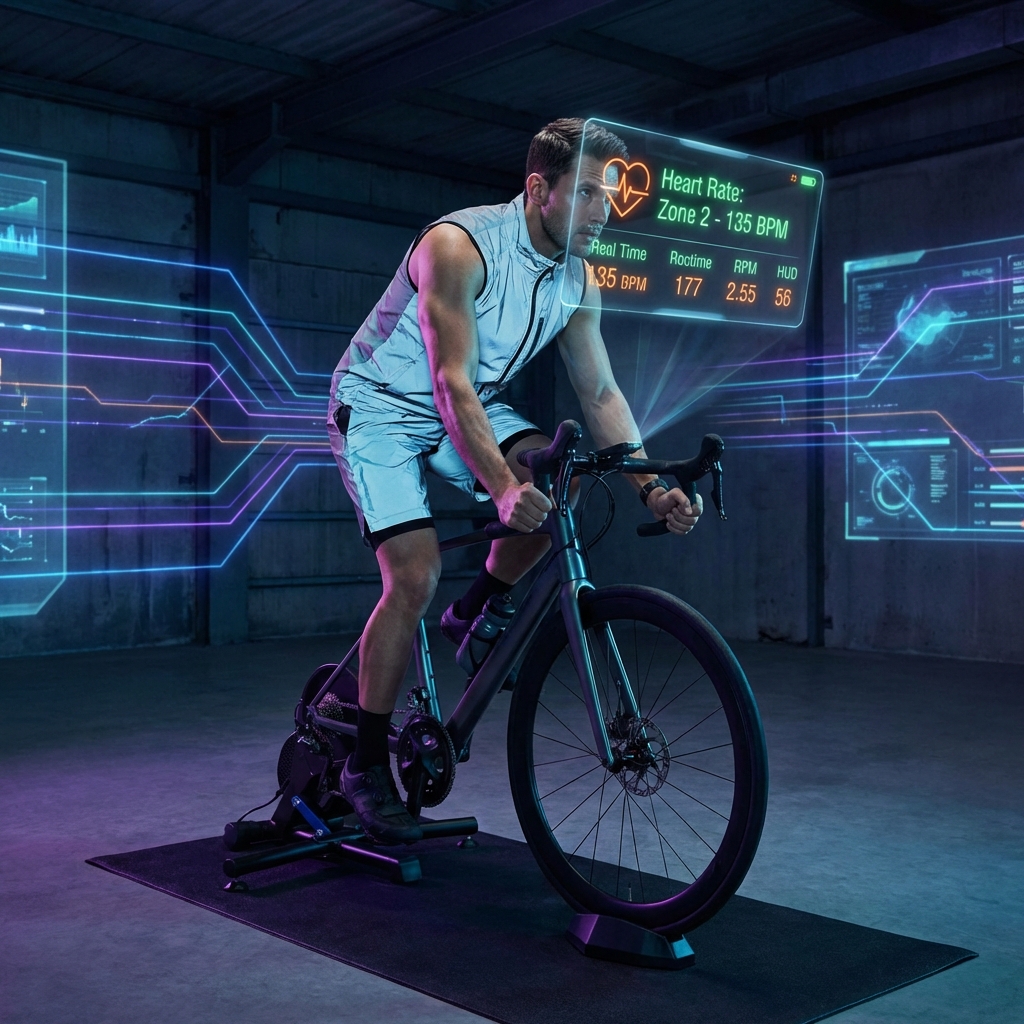
Zone 2 Training: The Foundation of Metabolic Flexibility
Transparency Disclosure: This article contains affiliate links. If you purchase through these links, we may earn a small commission to support our research. We only recommend products we personally trust.
The Paradox of Performance
In a world obsessed with “High-Intensity Interval Training” (HIIT) and “Go Hard or Go Home” mentalities, the secret to elite performance and longevity is counterintuitive: You need to slow down.
Zone 2 training is not just a trend; it is the physiological foundation upon which all other physical adaptations are built. Whether you are a Tour de France cyclist, an elite marathoner, or a 45-year-old executive wanting to live to 100 without chronic disease, Zone 2 is your most powerful tool.
This comprehensive guide will deconstruct the science of Zone 2, why it is critical for mitochondrial health, and how to implement it into your weekly protocol.
What is Zone 2?
Zone 2 is a specific metabolic state where your body is generating energy primarily through the oxidation of fat within your mitochondria.
Exercise intensity is often categorized into 5-7 zones. Zone 2 represents an effort level that is “easy” enough to sustain for hours but “hard” enough to elicit a training response.
The Metabolic Definition
Technically, Zone 2 is defined as the intensity at which you are at or just below your aerobic threshold (AeT). In this zone, your lactate levels remain steady (usually below 2.0 mmol/L). Your body is clearing lactate as fast as it is producing it.
When you push harder (Zone 3, 4, 5), you switch from burning fat to burning primarily carbohydrates (glycogen). This shift creates more lactate than your mitochondria can clear, leading to fatigue.
Key Distinction: Zone 2 is the maximum intensity where fat oxidation is maximized.
The Science: Mitochondria & Metabolic Flexibility
Why does this matter? Because mitochondrial dysfunction is at the root of nearly every chronic disease: Type 2 diabetes, metabolic syndrome, cancer, cardiovascular disease, and neurodegeneration.
1. Mitochondrial Density and Efficiency
Training in Zone 2 significantly increases both the number (density) and quality (efficiency) of your mitochondria. It teaches your body to build a massive engine capable of burning fat for fuel.
If you only do high-intensity training (HIIT), you improve your “turbocharger” (glycolytic system) but neglect the “base engine” (aerobic system). A large base engine allows you to:
- Recover faster between high-intensity efforts.
- Sustain power for longer durations.
- Burn body fat at rest.
2. Metabolic Flexibility
Metabolic flexibility is the ability of your body to switch seamlessly between fuel sources. A metabolically flexible person burns fat while sitting at a desk, walking, or doing light exercise, and only switches to glucose when sprinting or lifting heavy.
A metabolically inflexible person (often due to insulin resistance) burns glucose even at rest. This leads to energy crashes, sugar cravings, and inability to lose body fat. Zone 2 training cures this by forcing the body to become a fat-burning machine.
3. Iñigo San Millán’s Research
Dr. Iñigo San Millán, the physiologist for Tadej Pogačar (multi-time Tour de France winner), has shown that elite cyclists spend 80% of their training time in Zone 2. This allows them to clear huge amounts of lactate, which they can actually use as a fuel source.
Identifying Your Zone 2
You don’t need a lab to find your Zone 2, though a metabolic cart test is the gold standard. Here are three practical ways to find it:
1. The “Talk Test” (Most Practical)
This is surprisingly accurate. You should be able to hold a conversation, but it should feel slightly strained.
- If you can sing a song, you are in Zone 1 (too easy).
- If you can talk in full sentences but would rather stop talking to breathe, you are in Zone 2.
- If you have to gasp for air between words, you are in Zone 3 (too hard).
2. Heart Rate Formula (Rough Estimate)
The old “220 minus age” formula is notoriously inaccurate. A slightly better metric is the Maffetone Method:
- 180 - Age = Upper Limit of Zone 2 HR
Example: If you are 40 years old: 180 - 40 = 140 BPM. Your Zone 2 range is roughly 130-140 BPM. Adjustments:
- Subtract 5 if you are recovering from illness or are sedentary.
- Add 5 if you have been training consistently for 2+ years without injury.
3. Lactate Testing (The Data Nerd Approach)
If you track biomarkers, you can buy a portable lactate monitor (like Nova Biomedical). Prick your finger during exercise. Zone 2 is defined as the intensity where lactate is between 1.7 and 1.9 mmol/L. Once you cross 2.0 mmol/L, you are likely entering Zone 3.
The Protocol: How to Implement Zone 2
Frequency: 3-4 sessions per week. Duration: 45-90 minutes per session.
Wait, 45 minutes? Yes. The biological signal for mitochondrial biogenesis (creating new mitochondria) doesn’t peak until about 30-45 minutes into the session. A 20-minute jog does not provide the same stimulus.
The ideal weekly structure (The 80/20 Rule):
- Monday: Zone 2 Run/Ride (60 mins)
- Tuesday: Strength Training (Heavy)
- Wednesday: Zone 2 Incline Walk/Ruck (45-60 mins)
- Thursday: Strength Training (Hypertrophy)
- Friday: Zone 5 / VO2 Max Intervals (The other 20% of cardio)
- Saturday: Long Zone 2 Activity (90+ mins)
- Sunday: Rest / Mobility
Best Modalities for Zone 2
You need an activity where you can control output steadily.
- Stationary Bike / Peloton: Easiest to control power/HR. No traffic, no hills.
- Rucking: Walking with a weighted backpack (30-50lbs). Turns a walk into a Zone 2 workout without the impact of running.
- Incline Treadmill Walking: “12-3-30” protocol (12% incline, 3mph, 30 mins) is a classic example of Zone 2 for many.
- Rowing / Elliptical: Good full-body engagement.
- Running: Caution. For many people, running spikes heart rate into Zone 3 immediately. If you can’t run while keeping your HR under 140-150, you should walk/run or cycle until your aerobic base improves.
Common Mistakes
1. The “Junk Miles” Trap
This is the most common error. People go “kind of hard.” They aren’t going easy enough to get the Zone 2 fat-burning benefits, but they aren’t going hard enough to get the Zone 5 VO2 max benefits. They sit in “The Black Hole” (Zone 3/4). This accumulates fatigue without optimizing the aerobic engine. Discipline is required to go slow.
2. Under-fueling
While Zone 2 burns fat, you still need hydration. For sessions under 90 minutes, water and electrolytes are fine. For longer sessions, you don’t necessarily need carbs (glycogen is preserved), but ensure you aren’t fasting if performance is the goal, unless you are specifically training “fasted cardio” for fat adaptation.
3. Relying Only on Heart Rate Monitors
Cardiac drift is real. In a 60-minute session, your HR might drift up 5-10 beats due to heat and dehydration, even if effort remains the same. Use a combination of HR and “Rate of Perceived Exertion” (RPE). Zone 2 is an RPE of 3-4 out of 10.
Zone 2 and Longevity
Peter Attia, MD, widely regarded as a leading voice in longevity medicine, argues that poor cardiorespiratory fitness (low VO2 max) carries a higher risk of death than smoking, diabetes, or hypertension combined.
Your VO2 max is the size of your engine. Your Zone 2 base is the efficiency of that engine.
You cannot build a high peak (VO2 max) without a wide base (Zone 2).
The Cognitive Benefit
Zone 2 increases Brain-Derived Neurotrophic Factor (BDNF) roughly equivalent to high-intensity exercise but with less systemic cortisol stress. It promotes neuroplasticity and protects against Alzheimer’s. A steady-state ride is also a form of moving meditation, allowing for “diffuse mode” thinking which solves complex problems.
Conclusion
If you want to live longer, look better, and perform at your peak, you stop viewing “cardio” as a calorie-burning punishment and start viewing it as mitochondrial engineering.
Action Plan:
- Buy a chest strap heart rate monitor (more accurate than a watch).
- Calculate your Zone 2 (180 - Age).
- Commit to three 45-minute sessions this week.
- Keep it strictly below your limit. If you have to walk up a hill, walk.
Build the engine. The speed will follow.
Recommended Products
Hand-picked essentials for longevity, recovery, and peak performance.

NIVEA MEN Hyaluron
Anti-Aging Face Cream

Cellular 1-MNA
Anti-Aging Supplement

Bio Green Power
Superfood Blend

Massage Gun
Portable Heat Therapy
As an Amazon Associate we earn from qualifying purchases. Prices may vary.
Written by MensHealthInstitute Team
Evidence-based Longevity Research