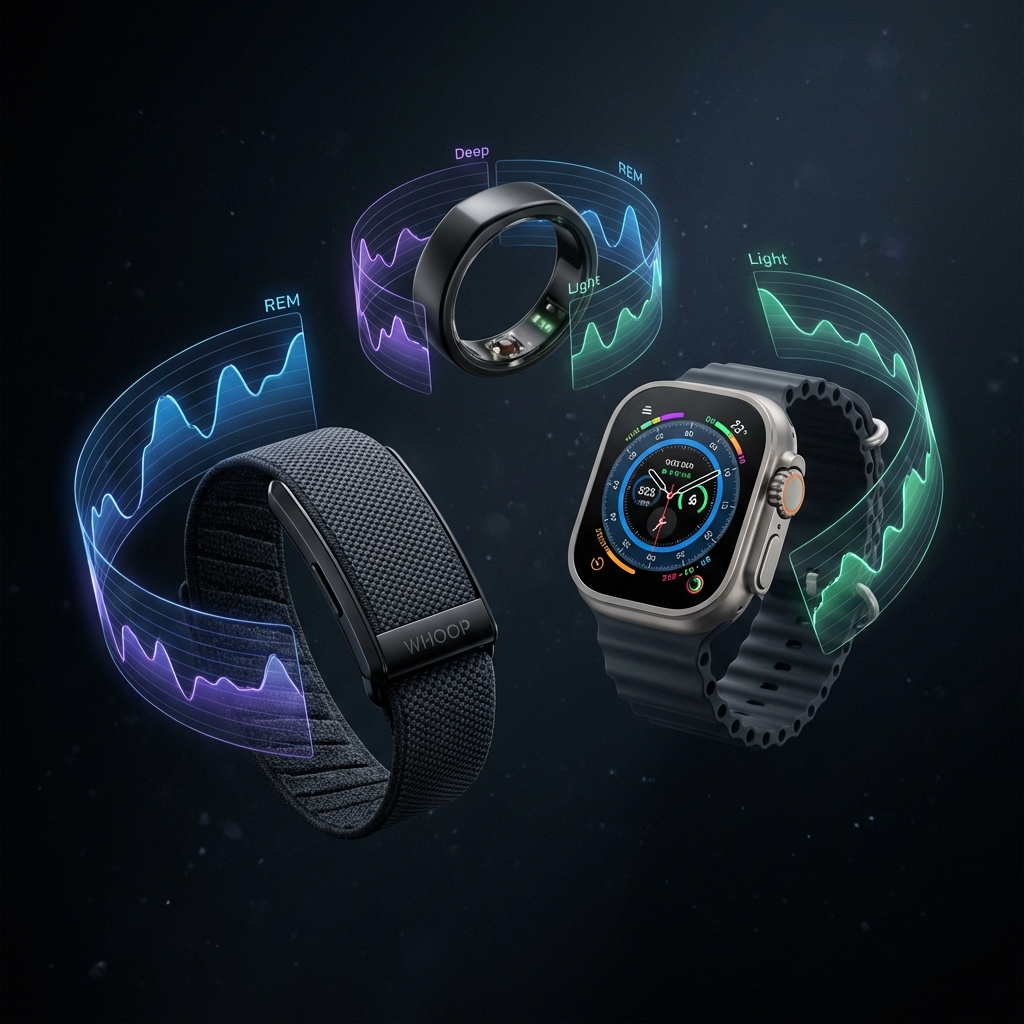
Oura vs. Whoop vs. Apple Watch: The Ultimate Sleep Tracker Comparison
Transparency Disclosure: This article contains affiliate links. If you purchase through these links, we may earn a small commission to support our research. We only recommend products we personally trust.
You Can’t Manage What You Don’t Measure
Sleep used to be simple: close your eyes, wake up. Today, it has become a competitive sport.
The “quantified self” movement has brought lab-grade sleep tracking to our wrists and fingers. But with data comes confusion. Do you need a subscription? Is a ring better than a watch? How accurate is that “REM Sleep” score?
We tested the big three—Oura Ring (Gen 4), Whoop 4.0, and Apple Watch Ultra (with watchOS 11)—to determine which one reigns supreme for the biohacker.
1. Oura Ring (The Specialist)
Design Philosophy: “I want to track my sleep, but I don’t want to look like I’m tracking my sleep.” The Oura Ring is jewelry first, tech second. Its form factor (a titanium ring) is arguably the best for sleep because it’s unobtrusive.
Pros:
- Form Factor: Most comfortable to wear 24/7. No screen to distract you.
- Battery Life: 5-7 days.
- Recovery Metrics: The “readiness score” is holistic, blending sleep, HRV, and activity balance.
- Temperature Sensing: Extremely accurate (women use it for cycle tracking; men use it for early sickness detection).
Cons:
- Subscription: Requires a monthly fee ($5.99) for full data.
- Activity Tracking: Not great for lifting/HIIT (uncomfortable to grip a barbell).
- Price: Highest upfront cost ($299-$500).
Best For: Executives, minimalists, and those prioritizing pure health data over fitness tracking.
2. Whoop 4.0 (The Coach)
Design Philosophy: “You are an athlete. Optimizing recovery is your job.” Whoop is a screen-less fabric strap. It is relentless about data collection (100 times per second).
Pros:
- The “Strain” Score: Whoop quantifies cardiovascular load perfectly. It tells you exactly how hard you worked.
- Form Factor: Can be worn on wrist, bicep, or in underwear (Whoop Body). Bicep band is the gold standard for HR accuracy during movement.
- Journaling: The morning journal feature correlates behaviors (alcohol, magnesium, late meals) with recovery data. This is its killer feature.
- Battery: Charge while wearing it (battery pack slides on).
Cons:
- Subscription Only: You don’t own the hardware. You pay $30/month forever. Stop paying, it becomes a brick.
- No Screen: Cannot see time, pace, or notifications (pro for some, con for others).
- Sleep Staging: Often overestimates “Wake” time compared to PSG (Polysomnography).
Best For: CrossFitters, endurance athletes, and biohackers willing to log behaviors to find correlations.
3. Apple Watch (The Generalist)
Design Philosophy: “A computer on your wrist that happens to track sleep.” With the latest watchOS updates, Apple has quietly become a sleep tracking powerhouse.
Pros:
- Accuracy: In recent scientific validations (like those by The Quantified Scientist), Apple Watch series 8/9/Ultra consistently outperforms Oura and Whoop in sleep stage accuracy (REM/Deep vs. PSG).
- No Subscription: You buy it, you own the sleep data.
- Integration: Apps like “AutoSleep” or “Athlytic” can take raw Apple Health data and give you Whoop-like recovery scores for a one-time fee.
- Ecosystem: It does everything else (Siri, texts, payments).
Cons:
- Battery: The Achilles heel. Even the Ultra needs charging every 2 days. The regular series needs daily charging (usually means you charge while showering).
- Comfort: Wearing a bulky watch to bed is annoying for many. The green LEDs can be bright.
- Data Presentation: Apple Health’s native view is dry. You need 3rd party apps to make it actionable.
Best For: iPhone users who want “one device to rule them all” and care about raw accuracy over holistic coaching.
The Verdict: Accuracy vs. Actionability
Accuracy Winner: Apple Watch If you care about knowing exactly how many minutes of Deep Sleep you got, Apple’s sensors are currently the best optical sensors on the market.
Actionability Winner: Whoop Whoop doesn’t just show data; it coaches you. “You drank alcohol, your recovery tanked 15%.” “You slept 8 hours, push hard today.” The journaling feature changes behavior.
Lifestyle Winner: Oura It’s the easiest to live with. It disappears. The app is beautiful, calming, and focused on wellness rather than “crushing it.”
Summary
- Get Oura if: You hate watches or want the most passive experience.
- Get Whoop if: You are training for a marathon/competition and need to balance strain/recovery aggressively.
- Get Apple Watch if: You want the best raw data accuracy, don’t mind charging daily, and want a smartwatch features set.
A Warning on Orthosomnia
Do not let the data ruin your sleep. “Orthosomnia” is a condition where people get anxiety about their sleep scores, which ironically ruins their sleep. Use these tools to spot trends (e.g., “Alcohol destroys my HRV”), not to obsess over a single night’s score.
The goal is to feel rested, not to get a high score.
Recommended Products
Hand-picked essentials for longevity, recovery, and peak performance.

NIVEA MEN Hyaluron
Anti-Aging Face Cream

Cellular 1-MNA
Anti-Aging Supplement
Bio Green Power
Superfood Blend

Massage Gun
Portable Heat Therapy
As an Amazon Associate we earn from qualifying purchases. Prices may vary.
Written by MensHealthInstitute Team
Evidence-based Longevity Research