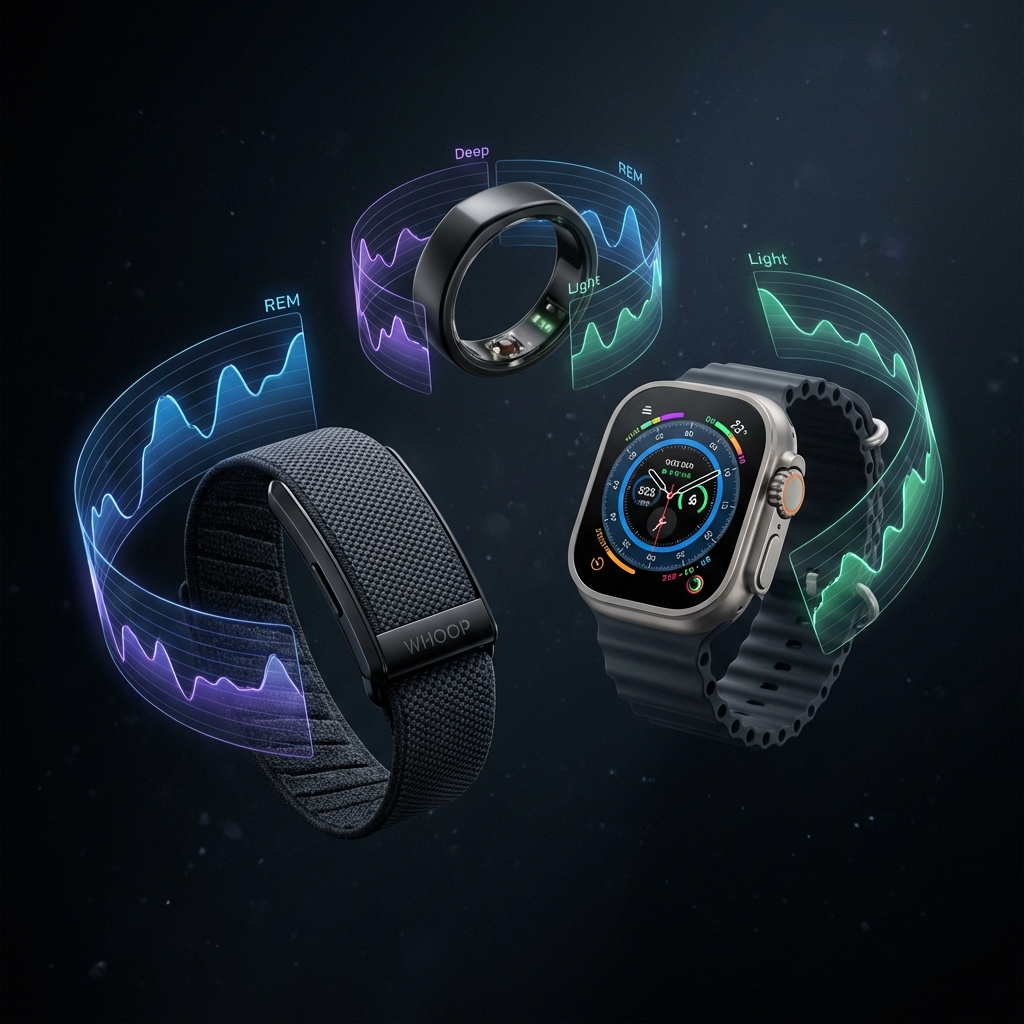
How to Choose a Wearable (Oura, Whoop, Watch) Without Falling for Marketing
Transparency Disclosure: This article contains affiliate links. If you purchase through these links, we may earn a small commission to support our research. We only recommend products we personally trust.
Wearables can be incredibly useful, but only if you understand one core idea: some metrics are measurements, while others are model outputs. The biggest mistake is treating a single score (“Recovery 42%”) as a verdict instead of a signal that needs context.
This guide gives you a practical filter: what to track, how to interpret trends, and how to avoid the most common data traps.
1) What wearables really measure (and what they estimate)
Most wrist- or ring-based devices use optical sensors (PPG) to infer heart rate from blood flow changes. In quiet conditions it is often solid. Under motion, cold skin, a loose strap, tattoos, or poor circulation, accuracy drops.
Typically more “hard” metrics:
- nightly resting heart rate (RHR),
- HRV measured at rest (device-specific method),
- sleep timing and total sleep (approximate),
- skin temperature trend (not a medical thermometer).
Typically more “soft” metrics (algorithms):
- sleep stages (REM/deep) - useful for trends, not diagnosis,
- readiness/recovery/strain scores,
- estimated VO2max or “fitness age”.
In practice, RHR and HRV are usually the most actionable because they respond quickly to sleep, alcohol, illness, dehydration, and training load.
2) The three metrics that actually change decisions
Resting heart rate (RHR)
If your nightly RHR is clearly above your baseline, common reasons include poor sleep, alcohol, dehydration, a brewing infection, or too much accumulated training stress.
HRV (heart rate variability)
HRV is a proxy for autonomic balance. Do not compare your HRV to other people. Compare your HRV to your own baseline. A meaningful drop for 2 to 3 nights in a row often signals that recovery is not keeping up.
Sleep duration + regularity
The best “HRV supplement” is often boring: a consistent bedtime and wake time. Wearables are good at revealing this because trends show up in data before you fully notice them subjectively.
3) A 7-day onboarding protocol (without obsession)
Days 1-2: Set your baseline
- wear the device consistently at night (night data is usually the most useful),
- wear it correctly (snug, stable, not painful),
- do not interpret the numbers yet.
Days 3-5: Make one controlled change Pick one variable:
- 30 to 60 minutes earlier to bed, or
- no alcohol, or
- earlier caffeine cutoff.
Compare your RHR/HRV trend and your morning energy.
Days 6-7: Adjust training with simple rules
- if RHR is elevated and HRV is suppressed: do an easier session (technique work, walking, Zone 2),
- if trends are stable: train as planned.
This is not “being soft”. It is dose control.
4) The most common interpretation traps
- One bad night is not regression. Use 7 to 14 day trends.
- Hard training can reduce HRV temporarily even when adaptation is happening.
- Alcohol often raises RHR and lowers HRV even if sleep time looks fine.
- Illness can show up in data early, but wearables do not diagnose.
- Sleep stages should be treated as directional, not absolute.
4a) How to test whether your data is trustworthy
Run a simple self-test:
- 3 nights with similar conditions (same schedule, no alcohol),
- check if RHR/HRV is reasonably stable,
- then introduce one change (late meal or short sleep) and see if metrics respond.
If your data is chaotic even under stable conditions, it is usually a wear/fit issue or signal artifacts.
4b) When to ignore the device and listen to your body
Ignore the score if:
- you are clearly sick and you already know you should rest,
- you feel exhausted despite “good” numbers,
- a single night looks scary but the 14-day trend is fine.
The best compromise rule: make decisions based on trend + how you feel + your plan, not on one number.
5) Five questions to choose the right device
- Is your priority sleep/recovery or performance tracking during workouts?
- Will you actually wear it daily?
- Do you want a strong ecosystem and integrations?
- Do you prefer a discreet ring or a full-featured watch?
- Are you okay with a subscription model?
6) Minimum app features you should not compromise on
To make data usable, look for:
- 7/30/90 day trend views,
- easy exports or integration (Apple Health / Google Fit),
- tags/notes (alcohol, late meal, heavy training) so metrics have context.
If the app hides raw trends and only shows a “score”, it becomes frustrating quickly.
7) The best use case: early warning signals
Wearables shine when they catch patterns you might miss: rising resting heart rate, suppressed HRV for several nights, or a steady decline in sleep time. Treat these as prompts to simplify your week (sleep, hydration, easier training) before a small problem becomes a full crash.
Bottom line
A wearable is worth it if it helps you make simple decisions: go to bed earlier, reduce alcohol, plan training stress better, and catch overload early. Focus on RHR, HRV, and sleep regularity, and treat all “scores” as hints.
This is not medical advice. If you have palpitations, fainting, persistent insomnia, or symptoms of sleep apnea, talk to a clinician and consider proper diagnostics.
Recommended Products
Hand-picked essentials for longevity, recovery, and peak performance.

NIVEA MEN Hyaluron
Anti-Aging Face Cream

Cellular 1-MNA
Anti-Aging Supplement
Bio Green Power
Superfood Blend

Massage Gun
Portable Heat Therapy
As an Amazon Associate we earn from qualifying purchases. Prices may vary.
Written by MensHealthInstitute Team
Evidence-based Longevity Research