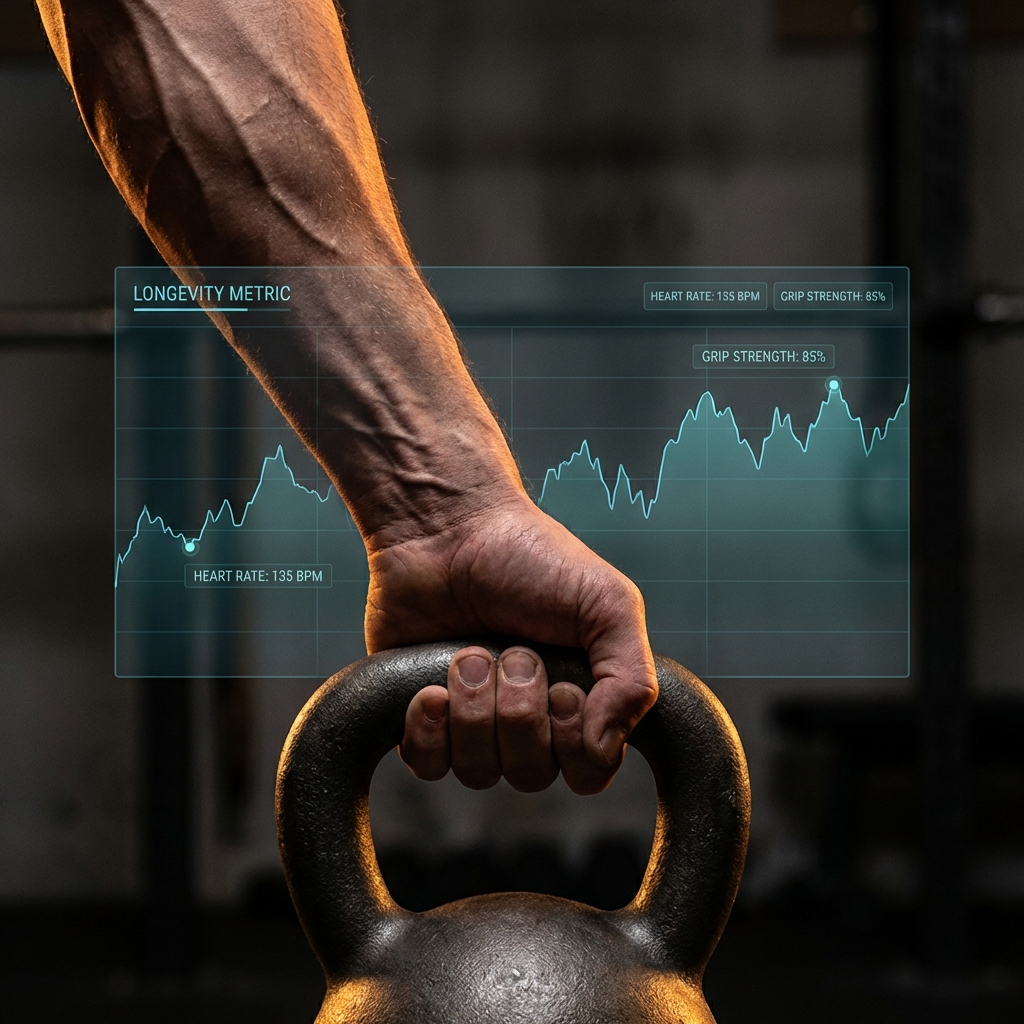
Grip Strength: The Surprising Biomarker of Longevity
Transparency Disclosure: This article contains affiliate links. If you purchase through these links, we may earn a small commission to support our research. We only recommend products we personally trust.
The Handshake Test
Imagine if you could shake someone’s hand and instantly know their biological age, their risk of heart disease, and their likelihood of developing dementia.
According to a massive body of epidemiological research, you essentially can.
Grip strength is one of the most robust biomarkers of aging we have. A study published in The Lancet (tracking 140,000 adults across 17 countries) found that grip strength was a better predictor of all-cause mortality than systolic blood pressure.
We often focus on VO2 Max (cardio) and muscle mass (hypertrophy), but functional strength—specifically the ability to exert force with your hands—is the “check engine light” for your nervous system and skeletal muscle health.
Why Grip Strength Matters
It’s not just about opening jars. Your hands are the primary interface with the physical world.
1. A Proxy for Total Body Strength
You rarely have a weak body and strong hands. Grip strength correlates highly with muscle mass index, leg power, and core stability. It is a “proxy metric” for overall neuromuscular integrity. If your grip is declining, your entire musculoskeletal system is likely degrading (sarcopenia).
2. Neurological Health
Grip strength is a measure of neural drive—how efficiently your brain recruits motor units. A weak grip is often an early sign of central nervous system (CNS) decline. Studies show reduced grip strength precedes cognitive decline and Alzheimer’s diagnosis by years.
3. Injury Prevention (The “Anti-Frail” Metric)
For older adults, the leading cause of injury-related death is a fall.
- Strong grip = Better ability to catch yourself (or grab a railing).
- Strong grip = High bone density (wolf’s law: muscles pull on bones, making them stronger).
- Weak grip = Frailty.
Testing Yourself: Where Do You Stand?
You need a hydraulic hand dynamometer (standard medical equipment, costs ~$30-50).
The Protocol:
- Stand with feet shoulder-width apart.
- Hold the dynamometer at your side (arm straight down but not touching body).
- Squeeze as hard as possible for 3-5 seconds.
- Test both hands, take the average of 3 attempts.
The Standards (Men):
- Elite: > 60 kg (> 132 lbs)
- Strong/Healthy: 50-60 kg (110-132 lbs)
- Average: 40-50 kg (88-110 lbs)
- Weak/At Risk: < 40 kg (< 88 lbs)
- Critically Low: < 26 kg (Clinical diagnosis of Sarcopenia)
Note: As you age, these numbers naturally decline, but your goal should be to stay in the “Elite” category for your age group to buffer against decline.
How to Train for “Old Man Strength”
We’ve all met that 60-year-old mechanic or farmer who looks average but has a handshake like a vice grip. That is “old man strength”—tendon density and neural efficiency built over decades of manual labor.
You can simulate this in the gym. Here is the protocol.
1. The Dead Hang (Decompress & Strengthen)
As simple as it sounds. Hang from a pull-up bar.
- Protocol: 3 sets of “Max Time” at the end of every workout.
- Goal: Accumulate 5 minutes total hanging time per week.
- Standard: If you can’t hang for 60 seconds, your grip is a limiting factor.
- Bonus: This decompresses the spine and opens up the shoulders (great for desk workers).
2. The Farmer’s Carry (Loaded Carries)
The single most functional exercise for longevity. Pick up heavy things and walk.
- Protocol: Heavy dumbbells or kettlebells (half bodyweight total is a good start).
- Distance: 40-50 meters.
- Cues: Chest up, shoulders back, no slouching. This builds grip, traps, postural muscles, and core stability simultaneously.
- Frequency: 1-2x per week.
3. Thick Bar Training (Fat Gripz)
If you can’t buy a thick axle bar, buy “Fat Gripz” (rubber sleeves that fit over barbells).
- Making the bar thicker forces your hand open, reducing mechanical advantage and forcing the forearm muscles to work 2-3x harder.
- Use on: Bicep curls, Rows, Deadlifts (warmups only).
- Do NOT use on: Max effort lifts (your grip will fail before the target muscle).
4. Direct Forearm Work
- Plate Pinches: Hold two smooth weight plates together (smooth side out) with just your fingers.
- Rice Bucket: Dig your hands into a bucket of rice and open/close/twist. It sounds silly, but it’s a staple for baseball pitchers and climbers for tendon health.
The Longevity Rx
Grip strength is not just for powerlifters. It is a vital sign.
Weekly Prescription:
- Buy a dynamometer and baseline your strength.
- Add Farmer’s Carries to your leg day or back day.
- Do Dead Hangs every morning (install a bar in a doorway) to decompress and strengthen.
Don’t let your ability to interact with the world fade. Grip it and rip it.
Recommended Products
Hand-picked essentials for longevity, recovery, and peak performance.

NIVEA MEN Hyaluron
Anti-Aging Face Cream

Cellular 1-MNA
Anti-Aging Supplement
Bio Green Power
Superfood Blend

Massage Gun
Portable Heat Therapy
As an Amazon Associate we earn from qualifying purchases. Prices may vary.
Written by MensHealthInstitute Team
Evidence-based Longevity Research